

The ordinary death of an extraordinary civil rights icon
written by Donna Britt from the Washington Post
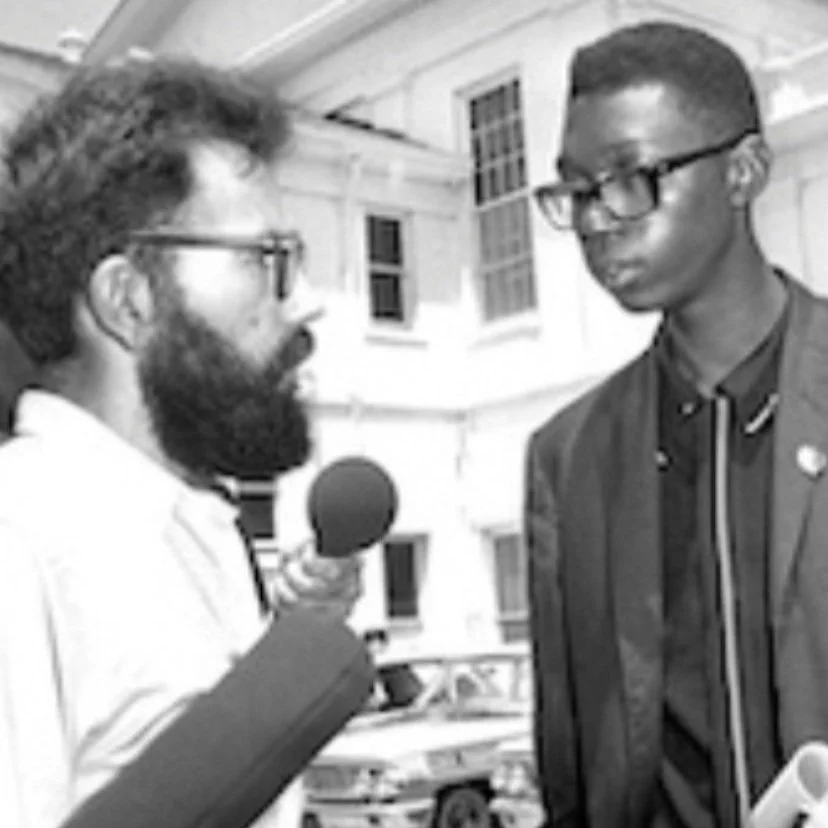
Leroy Moton, right, who was riding in the car with activist Viola Liuzzo when she was shot to death, stands in front of the courthouse in Hayneville, Ala., on May 4, 1965, during the trial of the Klansman charged with the slaying. (Horace Cort/AP) Almost 60 years after dashing into the history books as a terrified teenager in one of the civil rights era’s most infamous killings, Leroy Moton died quietly last September at age 78.
In 2019, I interviewed Moton, who had been a bespectacled Alabama high-schooler the night he survived the 1965 Ku Klux Klan shooting of Viola Liuzzo, the only White woman slain in the civil rights movement. He described how hours after marching from Selma to Montgomery with Martin Luther King Jr. and 25,000 other protesters, he was riding back to Selma with Liuzzo in the passenger seat of her Oldsmobile when a carload of White men spotted them. Infuriated to see a young Black man with the blonde nursing student, they fired into the car, which swerved and crashed. Knocked unconscious, Moton awakened in the darkness beside Liuzzo’s motionless body. Fearing the killers were nearby, he sprinted in work boots through murky farmland and ran briefly back to the car before tearing onto the deserted highway. Finally, he flagged down a Selma-bound truck filled with weary marchers that took him to safety.
Liuzzo’s murder was so highly publicized that it astonished even me — an Indiana fourth-grader shocked that the brutes murdering “Negro” activists down south had actually killed a White woman. Liuzzo’s death left her five children motherless, her Teamsters executive husband devastated, and FBI Director J. Edgar Hoover busy inventing salacious falsehoods to discredit Liuzzo, 39, and Moton, and to distract people from the fact that one of his undercover agents had been in the car with her killer. Yet the most consequential impact of Liuzzo’s slaying was that it inspired Congress to pass the stalled Voting Rights Act of 1965. Five days after her death, King, future congressman John Lewis, Teamsters President Jimmy Hoffa and 350 others crowded into a Detroit parish for her funeral.
Fifty-eight years later, fewer than 40 mourners gathered at a funeral home in Hartford, Conn., on Sept. 22 to memorialize Moton. Several rows of pews were empty. The obscurity of Moton’s funeral, a week after his death from cancer, felt “tragic” to Lisa Nkonoki, a Black Hartford-area public relations professional whom funeral director Howard K. Hill contacted after receiving Moton’s body. “He called me and said, ‘I think I have someone here of some note,’” Nkonoki says. After learning more about Moton’s largely forgotten history, Nkonoki “felt sick that this man hadn’t been honored more.”
Six decades is a long time. Long enough for that fleet, 19-year-old runner‘s work boots to be replaced by gray Skechers that Moton wore to shuffle his still-lanky 6-foot-4 frame behind a metal walker. Long enough for him to marry, divorce, father a beloved son bearing his name, and to register voters in Illinois, Michigan, and Georgia before settling in Hartford in 1969 to become a machinery company foreman. Long enough for Moton to realize that for as long he lived, he would feel haunted by Liuzzo’s death — “Time was, I wished it was me instead of her. She had five kids.” — and be terrified while driving down dark, two-lane highways. The attack remained “fresh in his mind,” says Moton’s namesake, Leroy Jr., 35, a Stamford television production manager. “He said he thought about it every day.”
Most surprisingly, six decades was long enough for the Voting Rights Act — now established law whose passage Moton spent his entire adult life being proud of — to be threatened. On Nov. 20, a federal appeals court ruled that only the federal government — not private citizens and civil rights groups as is customary — are allowed to sue under a key section of the landmark civil rights law. Considering that about 90 percent of successful lawsuits under the act are brought by private plaintiffs and groups, the decision effectively deals a death blow to the historic legislation in seven states. Almost certain to be appealed, the ruling will probably end up in the Supreme Court.
In many ways, it makes sense that Moton — once a bright but unremarkable teen who after his brush with fame lived a full but unremarkable life — would pass without fanfare. “I would have been shocked had it not happened that way,” says Russ Wigginton, president of the National Civil Rights Museum, housed in the historic Lorraine Motel, where King was assassinated. Wigginton had heard of Moton but only learned of his death when I informed him of it. In his view, Moton’s common-man status “makes his early sacrifice more meaningful.” In speeches, Wiggington often reminds people that most seismic societal change isn’t wrought by icons such as King and Gandhi, but by “everyday people whose ordinariness made their actions more powerful.” A longtime educator, he says that “explaining to young people how regular folks did some of the [courageous] things they did creates a really empowering mind-set. It teaches them that people who seem ordinary may have done extraordinary things.” Moton’s namesake couldn’t agree more. The singular moment foisted on his dad “could’ve happened to anybody,” he says. “The movement was just regular people collectively trying to make a difference.” Though his father was “very modest,” he continues, that doesn’t mean he didn’t enjoy talking about his days in the struggle. “People he’d meet, if he got into a long conversation, he’d bring up working with Jesse [Jackson], MLK, the marches,” Moton Jr. says.
Interviewing the elder Moton, I found him thoughtful and accommodating. Yet it was difficult for him to explain what I most wanted to understand: What was it like, crafting a second act after being catapulted at age 19 into your life’s defining moment? Many of us know of gifted student-athletes whose glory days ended at graduation, who struggled over engaging the world in the decades left to them. But athletes spend years training to be ready for whatever big moment awaits them. How does one prepare to become the inadvertent sidekick to a martyr? Surviving that ink-black night allowed Moton to slide back into the comforting normalcy denied to civil rights heroes such as King, Emmett Till, and Liuzzo — victims frozen not just in time, but also in our imaginations. Who might they have become? Sidestepping martyrdom, Moton got to embrace all that’s extraordinary about ordinary life — cheering favorite teams, guffawing at family gatherings, gasping over July Fourth fireworks, falling in and out of love, crying at kids’ graduations, and perhaps evolving into someone you never dreamed you could become.
As his notoriety faded, the elder Moton seemed unfazed by people forgetting the horror he survived, including the terror any Black Southerner would have felt testifying in 1965 at four trials against a quartet of White men in Liuzzo’s killing (two received 10-year prison sentences). What did trouble him was folks taking for granted what his and other activists’ efforts produced: more equality for all Americans and the lesson that those rights deserve appreciation and protection. When it became clear last summer that the legislation Liuzzo’s death had spurred was endangered, neither Moton Jr. nor his dad quite believed it. “We agreed it kind of defeated the purpose of what my dad did in 1965,” Moton Jr. says. “It’s mind-boggling that in 2023 we appear to be going backward.” Deaths such as Moton’s are a painful reminder . . . that even the youngest activists of the 1950s and ’60s are passing on, even as old threats resurface.
“People gave their lives so you can vote.”
Donna Britt, a former Washington Post columnist, is the author of “Brothers (and Me): A Memoir of Loving and Giving.”
This article has been edited for brevity.